

Understanding your heart rate zones is one of the easiest ways to make your training more effective. Whether you’re preparing for your first 5K or chasing a marathon personal best, training at the right intensity helps you improve endurance, increase speed and reduce the risk of injury.
Many runners make the mistake of running every workout at roughly the same effort. They push too hard on easy days and not hard enough during quality sessions. Heart rate training removes the guesswork by helping you understand exactly how hard your body is working.
In this guide, we’ll explain each heart rate zone, what it feels like, when to use it and why elite runners spend most of their training surprisingly slowly.

What Are Heart Rate Zones?
Heart rate zones divide exercise intensity into five levels based on the percentage of your maximum heart rate (HRmax).
As exercise intensity increases, your heart pumps faster to deliver oxygen-rich blood to your muscles. Each zone places different demands on your cardiovascular system, producing different training adaptations.
The most common way to estimate your maximum heart rate is:
Maximum Heart Rate = 220 – Your Age
For example, if you’re 35 years old:
220 – 35 = 185 beats per minute (bpm)
Your training zones are then calculated as percentages of this number.
Keep in mind that this formula provides only an estimate. Sports laboratories and field tests can determine your true maximum heart rate more accurately.
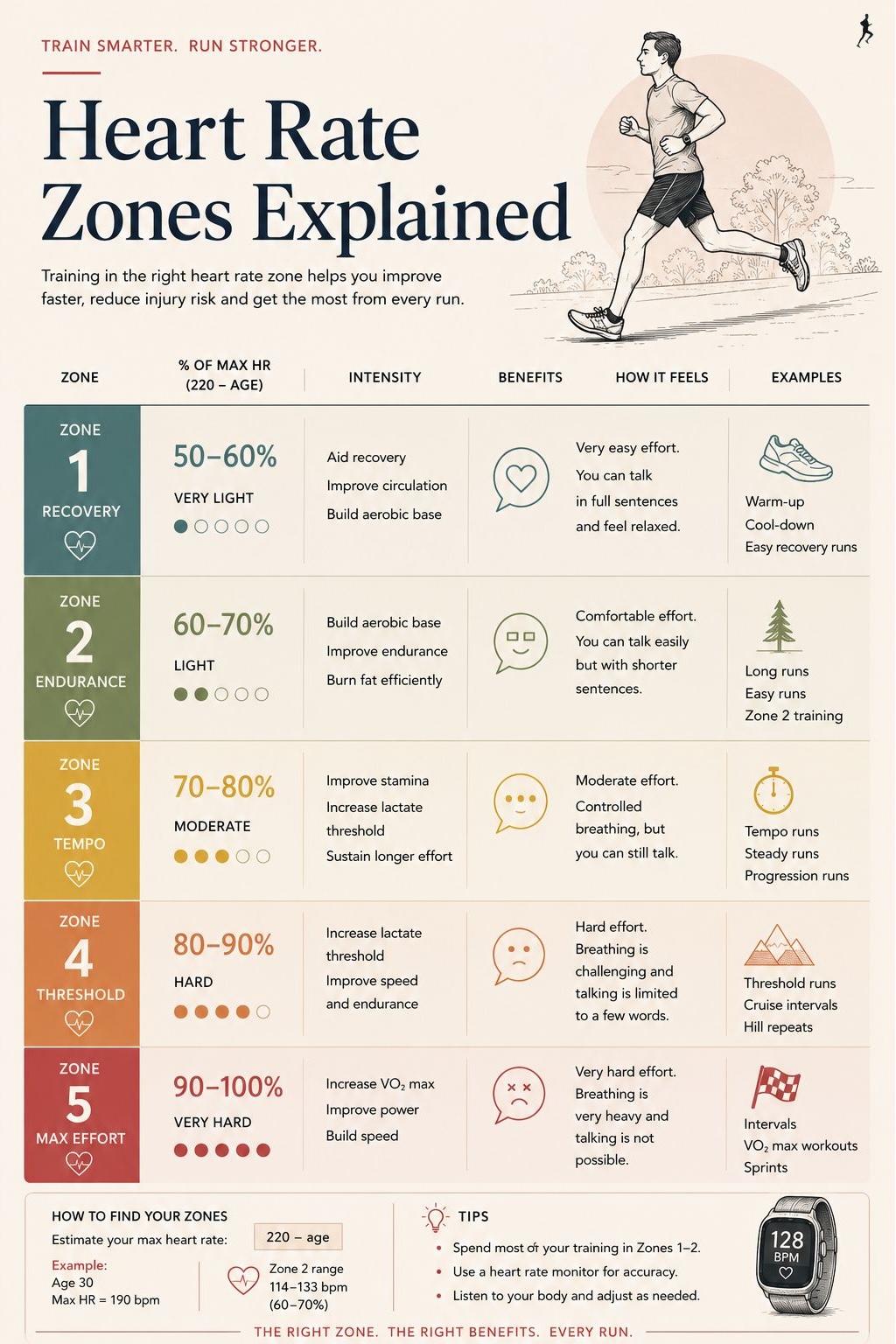
Zone 1: Recovery (50–60%)
What it feels like
Zone 1 feels extremely easy. You can comfortably hold a conversation and barely notice your breathing.
Typical activities include:
- Walking
- Warm-ups
- Cool-downs
- Recovery runs
- Easy cycling
Benefits
Training in Zone 1 helps:
- Increase blood circulation
- Promote recovery
- Reduce muscle soreness
- Prepare the body for harder sessions
While it doesn’t significantly improve fitness on its own, it plays an important role between tougher workouts.
Zone 2: Endurance (60–70%)
Zone 2 has become one of the hottest topics in endurance sports—and for good reason.
This is where your body becomes more efficient at using fat as fuel while building a stronger aerobic engine.
What it feels like
You should still be able to speak in complete sentences without gasping for breath.
Many runners are surprised by how slow Zone 2 actually feels.
Benefits
Running in Zone 2 helps:
- Improve aerobic endurance
- Increase mitochondrial density
- Build capillaries around muscles
- Improve fat metabolism
- Delay fatigue
- Develop a stronger endurance base
This is the foundation of marathon training and long-distance running.
Why elite runners love Zone 2
Research shows that many elite endurance athletes spend approximately 70–80% of their training at low intensity, with much of it falling within Zones 1 and 2.
This allows them to recover faster while still accumulating a high weekly training volume.
Zone 3: Tempo (70–80%)
Zone 3 sits in the middle of the intensity spectrum.
It’s harder than an easy run but still sustainable for a longer period.
What it feels like
Breathing becomes noticeably heavier, although you can still speak in short sentences.
Best workouts
- Tempo runs
- Marathon pace runs
- Steady-state runs
- Progression runs
Benefits
Training in Zone 3 helps:
- Improve muscular endurance
- Increase stamina
- Raise aerobic capacity
- Prepare you for sustained race efforts
Zone 4: Threshold (80–90%)
Zone 4 is where training starts becoming challenging.
Here, your body begins producing lactate faster than it can remove it.
Learning to tolerate this intensity is one of the most effective ways to improve race performance.
What it feels like
Speaking becomes difficult.
Breathing is deep and controlled, but the effort is demanding.
Common workouts
- Lactate threshold runs
- Cruise intervals
- Hill repeats
- Longer intervals
Benefits
Zone 4 training helps:
- Increase lactate threshold
- Improve running speed
- Boost endurance
- Enhance race performance
Most runners only spend limited time in this zone during structured workouts.
Zone 5: Maximum Effort (90–100%)
Zone 5 represents your maximum aerobic capacity.
You can only maintain this effort for a few minutes.
What it feels like
Talking is virtually impossible.
Your breathing is extremely heavy and your legs will quickly begin to fatigue.
Typical workouts
- Sprint intervals
- VO₂ max sessions
- Short hill sprints
- Track repeats
Benefits
Zone 5 training can:
- Improve VO₂ max
- Increase running speed
- Develop power
- Improve finishing kick
Because of the high stress it places on the body, this type of training should be used sparingly.
Which Heart Rate Zone Should You Train In?
Different workouts require different heart rate zones.
| Workout | Primary Zone |
| Recovery run | Zone 1 |
| Easy run | Zone 2 |
| Long run | Zone 2 |
| Marathon pace | Zone 3 |
| Tempo run | Zone 3–4 |
| Threshold intervals | Zone 4 |
| VO₂ max intervals | Zone 5 |
| Sprint training | Zone 5 |
A balanced training plan includes all five zones rather than focusing exclusively on one.
Do You Need a Heart Rate Monitor?
While you can estimate effort using the “talk test”, a heart rate monitor provides much greater accuracy.
Popular options include:
- Chest straps (most accurate)
- GPS running watches
- Optical wrist sensors
Modern watches from Garmin, Coros, Polar and Suunto can automatically calculate heart rate zones, monitor training load and suggest recovery times.
Common Heart Rate Training Mistakes
Running every workout too hard
Many recreational runners spend too much time in Zone 3, where the effort feels productive but recovery becomes difficult.
Ignoring recovery
Easy days are essential for improving fitness over the long term.
Chasing pace instead of effort
Heart rate naturally changes with:
- Temperature
- Humidity
- Hills
- Stress
- Fatigue
Using heart rate rather than pace helps ensure you’re training at the intended intensity.
Obsessing over exact numbers
Heart rate varies slightly from day to day. Think of the zones as useful ranges rather than strict limits.
Frequently Asked Questions
Which heart rate zone burns the most fat?
Zone 2 is generally considered the most effective intensity for improving your body’s ability to use fat as fuel. However, total calorie burn also depends on workout duration and overall intensity.
Is Zone 2 running too slow?
It often feels slower than expected, especially for newer runners. That’s completely normal. Building an aerobic base requires patience, and slowing down now can lead to faster race times later.
Should beginners use heart rate training?
Yes. Heart rate zones can help beginners avoid running too hard, making training more enjoyable and reducing the risk of injury or burnout.
How often should I train in Zone 5?
Most recreational runners only need one high-intensity session per week. The majority of weekly mileage should remain in Zones 1 and 2.
Final Thoughts
Heart rate training is one of the simplest ways to train smarter rather than harder. By matching your effort to the purpose of each workout, you’ll recover better, improve more consistently and reduce the risk of overtraining.
Remember that every run doesn’t need to be fast. In fact, the world’s best endurance athletes achieve their remarkable performances by spending most of their time running comfortably.
Master your heart rate zones, stay patient and trust the process. Over time, you’ll become a stronger, faster and healthier runner.